
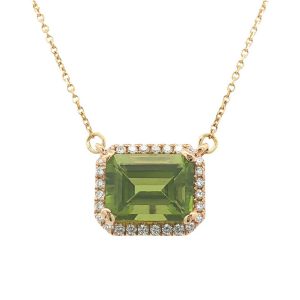
14K yellow gold pendant with emerald cut peridot surrounded by diamonds.
The height of summer. Warm sunshine. Long lazy days. Savoring the last of summer vacation. August! It’s fitting that its birthstone is Peridot with its warm, almost glowing, green color and lively sparkle. It is fascinating to explore Peridot’s celestially-related origins and history and how it’s used in jewelry today.
Peridot Fun Facts
- One of the few gemstones found in meteorites – actual pieces of space!
- One of the few gems that occur in only one color– always a shade of green.
- Sometimes confused with emerald – especially in ancient jewelry.
- Used in royal and religious treasures – including items in European cathedrals & Egyptian ruins.
- Formed deep in the Earth – about 20 to 55 miles beneath the surface.
Peridot History
- The name “peridot” may stem from the Arabic word faridat, meaning “gem.” The stone has been revered for thousands of years.
- Ancient Egyptians called Peridot the “Gem of the Sun” and it was a favorite of Cleopatra who had Peridots mined on the snake-infested island of Zabargad in the Red Sea.
- One of the most significant collections of Peridots is in the shrine of the Three Holy Kings in Cologne Cathedral, Germany. These gems were brought to Europe during the Crusades and are a testament to the gem’s enduring allure.
- Until the advent of the modern science of gemology in the early twentieth century, Peridot was often confused with other green gems. This happened with the sarcophagus of the Shrine of The Three Kings, pictured above. These Peridots were mistaken for emeralds.
Where Does Peridot Come From?
- Peridot forms deep within the Earth’s mantle, brought to the surface by volcanic activity. It is also found in extraterrestrial materials—specifically in Pallasite meteorites. These space-borne crystals are too small for jewelry use, but a fascinating part of peridot’s story.
- The mineral category of Peridot is olivine, all green, but rarely gem quality. This is the Papakōlea Green Sand Beach on the island of Hawaii, formed from olivine from nearby volcanoes.
- Today, the most significant peridot deposits are found in: Myanmar (Burma), China, Pakistan, Tanzania, the United States – notably in Arizona, where tribes have long treasured it
- Historically, the most famous source was Zabargad Island (formerly Topazios) in the Red Sea, off the coast of Egypt. This site dates back to Ancient Egyptian times and provided much of the peridot used in antiquity.
The Power and Symbolism of Peridot
Throughout history, peridot has been regarded as more than just a beautiful gem. Many cultures attributed mystical properties to it, believing it:
- Warded off evil spirits
- Promoted harmony and compassion
- Protected the wearer from nightmares
- Encouraged emotional balance and reduce stress
- Attracted prosperity and happiness
Peridot set in gold was thought to have even stronger powers, specifically in guarding against “terrors of the night.”
Even today, some still wear peridot as a talisman for peace, healing, and emotional clarity.
Peridot Characteristics & Care
- Peridot’s green comes from trace amounts of iron and ranges from pale yellow-green to rich olive-green. The most prized Peridots exhibit a medium toned, highly saturated, bright lime-green, from the perfect balance of iron and other trace elements.

Gorgeous peridot diamond pendant.
- Its radiant glow has earned it the nickname “evening emerald,” as it maintains its brilliance even in low lighting, like lamplight or candlelight.
- Like most gems, Peridot is doubly refractive, meaning it bends light in two directions instead of just one, causing double images of the facets as you look into the stone.

14K yellow gold checkerboard-cut peridot drop earrings.
- Peridot is 6.5 – 7 on the Mohs hardness scale (diamond is 10, ruby & sapphire 9) and is appropriate for most daily wear. The Mohs scale indicates how resistant a gem is to scratching. Thus, Peridot can be dulled over time by fine scratches from dust particles that can contain quartz (7 on the Mohs scale) which is harder than Peridot. So, it’s best to wash it with a soft brush, mild soap and water rather than wiping it with a cloth. Also, you should protect it from harsh chemicals and extreme temperatures. Like all jewelry, do not wear it while gardening, wood working, doing heavy housework, working out, etc.
Peridot today
- The largest Peridot in the world, in the Smithsonian, weighs 311.78 carats, and originally came from the aforementioned Zabargad Island.
- Look for prime gem examples in royal jewel collections. The Habsburg Parure is an exceptional peridot diamond set, circa 1825, made up of a tiara, necklace, earrings & brooch, from the estate of Countess Marina Coudenhove-Kalergi. These peridots are meticulously matched and highly saturated in color.
Conclusion

Peridots from our loose gem collection.
Whether worn as a birthstone or simply for its beauty, Peridot continues to inspire and captivate with its remarkable presence. So, if you’re looking for a bright gemstone that captures the spirit of summer, consider Peridot!
Visit our collection on our website or explore our searchable gem database.


