
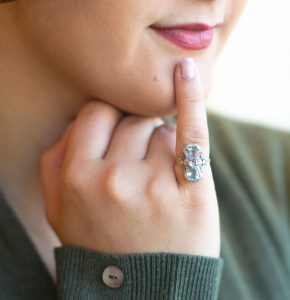
White gold vintage filigree ring with 2 hexagonal aquamarines
Starting a vintage jewelry collection comes down to three things: knowing what to look for, choosing pieces you’ll actually wear, and working with a jeweler to guide you through authenticity and condition. Begin with one or two defining items—say a ring or pendant—focus on craftsmanship before age alone, and build gradually. A strong collection is not built quickly but with intention.
Start With Something That Feels Like You
Start with jewelry you will wear because it speaks directly to you—something that feels natural, and that brings new light or perspective to your wardrobe.
Something that feels as if it comes from another era, yet already feels familiar. Something meaningful. Something distinctly yours.
- A ring that feels right the moment it’s on your hand.
- A pendant that shifts how everything else comes together.
- A pair of earrings that quietly changes your point of view.
That is your foundation. It sets your direction, defines your taste, and creates the connection that will shape your vintage jewelry collection.
Collector’s Note
The most compelling collections are not built around rarity. They’re built around consistency of taste.
What Defines A Strong Vintage Collection
If you’re just beginning, certain selections will shape your collection more clearly than others.
These are the ones we recommend starting with:
Vintage Diamond Rings
Look for rose cut, old mine cut or early brilliant-cut diamonds set in distinctive designs – cluster rings, three-stone rings, or geometric styles with baguette accents. These tend to feel immediately different from modern designs, which is exactly what gives them their unique appeal.
Pearl Jewelry
Vintage pearl pieces have a gentleness that is difficult to replicate today. You’ll often find:
- Graduated pearl strands
- Pearl and diamond cluster rings
- Simple pearl studs with warm overtones
The key is luster—not shine, but depth. Vintage pearls may have a more diffused rather than a bright reflection.
Diamond And Gem Clusters
Some of the most visually engaging styles to collect are sapphire and diamond clusters, ruby accents, or mixed gem compositions that create presence without relying on a single center stone.
Pendants And Lockets
Easy to wear and highly personal. Vintage pendants—especially those with engraving, filigree, or subtle gemstone accents—may be where to begin your collection.
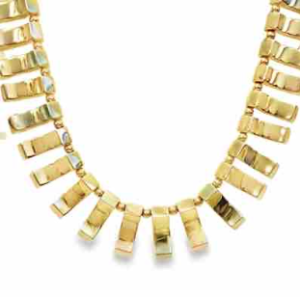
14 Karat yellow & rose gold Retro vintage festoon necklace.
Statement Gold Pieces
Heavier yellow or rose gold rings and bracelets from mid-century periods offer a different kind of appeal—less delicate, more sculptural.
Design Insight
Unsure where to start? Choose something that feels complete on its own. A strong vintage ring or pendant can become the foundation for everything that follows.
What Makes Vintage Worth Collecting
Not every older piece is worth collecting. The difference comes down to how clearly it expresses design, craftsmanship and personal taste.
Here’s what to prioritize:
Distinctive Stone Cuts
Older diamonds are cut differently—creating less sparkle (liveliness) and more dispersion (rainbow colors). They sparkle more slowly with larger splashes of dark and light.
Hand-Finished Detail
Look closely at the metalwork. Milgrain edges, engraving, and pierced filigree are all signs of hand-finishing. These details add texture and are rarely replicated at the same level today.
Balanced Proportions
Well-made vintage pieces feel intentional. Nothing looks oversized or out of place—the design holds together from every angle.
Material Integrity
Solid gold or platinum, not hollow or plated. The heft of a piece may tell you more than its appearance.
From The Jeweler’s Bench
Intricate vintage settings—especially those with fine filigree—should feel delicate, but not fragile. If a piece looks overly worn or thin, it may require restoration before regular wear.
Pearls In Vintage Jewelry: What To Look For
Pearls are one of the most nuanced categories in vintage jewelry—and one of the most rewarding when chosen well.
The most compelling tend to include:
Graduated Strands
Larger pearls at the center, tapering toward the clasp, creating a natural flow when worn.
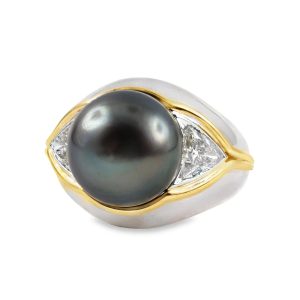
18 Karat white & yellow gold vintage ring set with a 11.5 mm black South Sea pearl & 2 trilliant diamonds totaling about 1 carat.
Pearl And Diamond Rings
A central pearl surrounded by small diamonds—soft, luminous, and distinctly vintage.
Baroque Pearls
More irregular in shape, more organic in character. These feel especially current today.
When evaluating pearls, look at:
- Color – white (though “blacks” (aubergine, mink, peacock) and goldens have a niche following).
- Overtone – some white pearls have a “rose” overtone, blacks may have a green, cinnamon, silver or purple
- Orient – baroque, semibaroque and some other pearls display iridescence.
- Luster – (reflectivity)
- Complexion – (slight blemishes are not uncommon)
- Shape – (should be pleasing to you – generally perfectly round are more expensive but not always more desirable).
- Condition – pearls are softer than gemstones and may show wear or need restringing).
Vintage Styles That Continue To Wow
Trends come and go, but certain styles are consistently relevant.
Geometric Diamond Rings
Clean lines, symmetry, and structured layouts. These pieces feel both vintage and modern at once.
Filigree And Lacey Metalwork
Delicate, detailed, and intricate. Often found in lighter, more refined items.
Gold-Forward Design
Rings and bracelets where gold itself is the focus thicker, warmer, more sculptural.
Cluster Designs
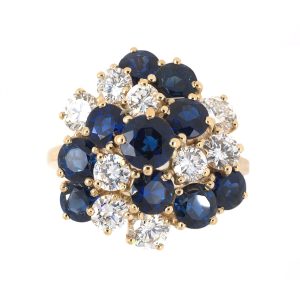
18Karat yellow gold vintage diamond & sapphire cluster ring
Multiple stones working together rather than one dominating center. These create visual richness and depth.
These styles draw attention not because they are bold, but because they are balanced and intentional.
Collector’s Note
Many are initially drawn to a specific era, but ultimately build a collection around how pieces feel when worn—not how categorized.
Building A Cohesive Collection
Once you have your first choice, the next step is not to diversify—it’s to refine.
A practical approach to create continuity:
- Stay within a similar color palette (all diamonds, or diamond with sapphire accents)
- Repeat certain design elements (milgrain, engraving, or cluster settings)
- Choose pieces that layer naturally
The collection should feel curated, not assembled.
What To Avoid Early On
A few things are worth being cautious about:
Buying For The Sake Of Variety
Too many different styles too quickly can make a collection feel scattered.
Overlooking Condition
A beautiful piece still needs to function. Loose stones, worn prongs, or thinning metal should be addressed before purchase.
Ignoring Comfort
If a ring catches or a bracelet feels too delicate, it likely won’t become part of your routine.
Expert Tip
If a piece feels slightly outside your comfort zone but continues to hold your attention, try it on. Vintage jewelry often makes more sense once you see it in motion.
A Personal Perspective
The best collections rarely start with a strategy.
They start with a moment.
- A ring that feels unexpectedly right.
- A strand of pearls that changes how you see your wardrobe.
- Something that doesn’t just look beautiful—but feels like it belongs to you.
From there, everything else becomes clearer.
Conclusion: Let Your Collection Take Shape Naturally
A vintage jewelry collection should feel considered, not rushed.
When you focus on pieces with strong design, thoughtful craftsmanship, and real presence—rings that define, pearls that soften, details that hold—you build something more than a collection.
You build a point of view.
If you’re ready to begin, we invite you to Explore Estate Treasures or Book a Private Appointment at Argo & Lehne. Seeing things in person—and understanding how they feel when worn—is where the process truly begins.


